


A Piece of My Mind as a New Era Begins
September 27, 2026
4 min
I can finish a day with twenty saved links and still be unable to explain one new idea clearly. Reading feels productive. Keeping up feels responsible. Neither tells me whether I can use what I have seen.
As an engineer, I care about learning tools. I am also learning to ask better product questions: who has this problem, what would improve their work, and what evidence would change my mind? More information does not answer those questions for me. I need time to try something, notice what failed and return with a better question.
The approach I want is small enough for one person or a team of three. It should work for someone learning a spreadsheet, planning a service or handling customer conversations, as well as someone writing code. It starts with choosing less.
I keep three places for new ideas: use now, try later and leave alone. These are my working categories, not a research finding. Most interesting links belong in the last two.
For the next two weeks, choose one recurring problem. Perhaps your report takes too long, a handover keeps losing details, or you cannot explain why a model’s result is wrong. Write one sentence about the outcome you want and one way to check it.
“Learn AI” leaves me with an endless queue. “Check whether this tool can produce a correct weekly summary from five approved notes” gives me a bounded experiment. The learning earns its time by helping with an actual decision.
A small team can agree on the same outcome while practising different parts. There is no need to turn everyone’s learning into another meeting or shared reading backlog.
After reading a short explanation, hide it. Write what you remember or explain the idea aloud. Then reopen the source and correct the gaps. This is retrieval practice: practising the act of bringing knowledge back, instead of only seeing it again.
In Roediger and Karpicke’s 2006 experiment, students either studied a passage four times or studied once and practised recall three times. At a one-week test, the repeated-recall group remembered 61% of the passage’s scored ideas, compared with 40% for repeated study. Immediately after learning, repeated study did better. These were university students recalling short passages, not a measurement of workplace productivity. Original study, Experiment 2.
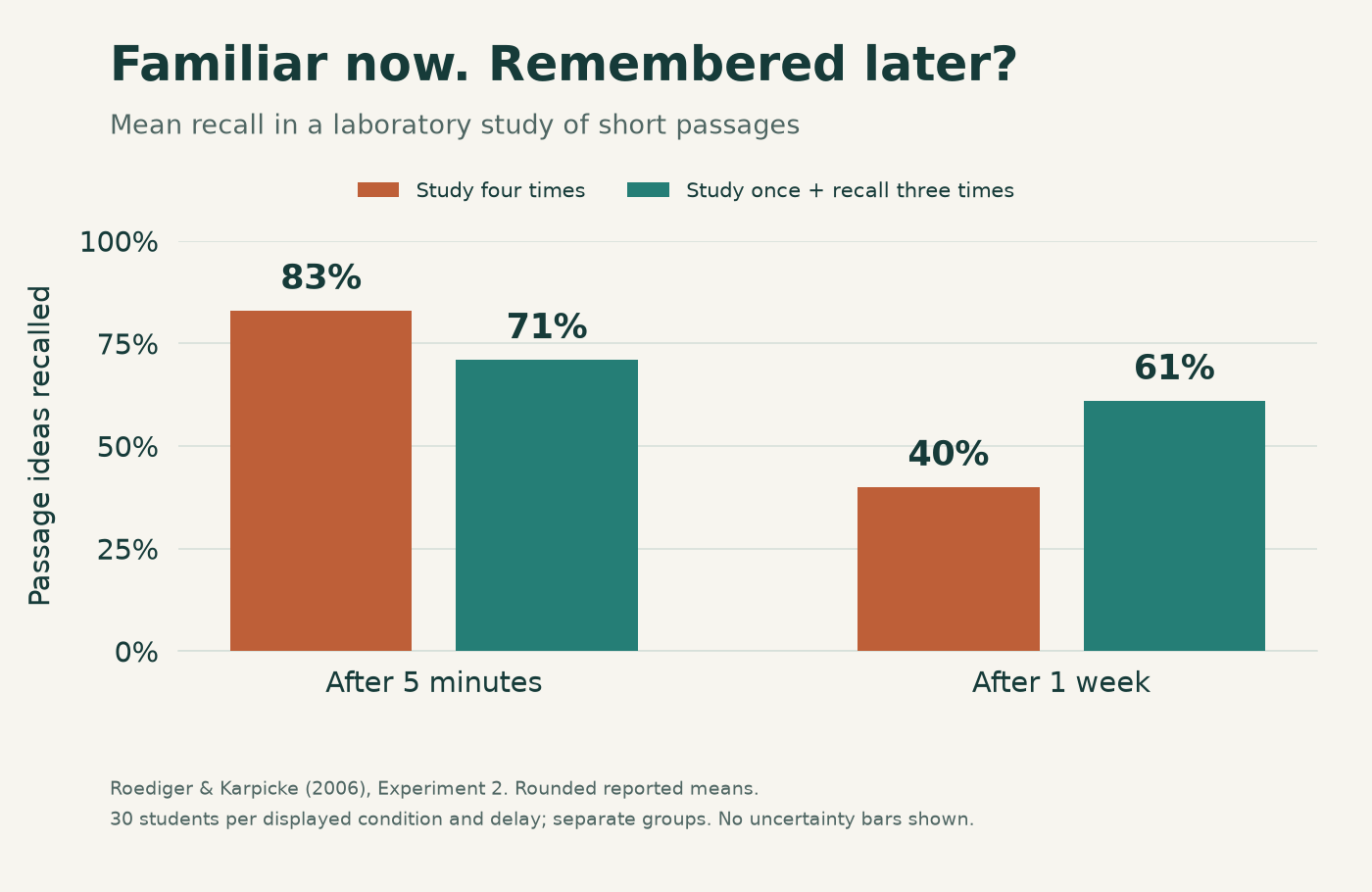
Rounded means reported in Experiment 2, Figure 2, pages 252 to 253. Thirty participants per displayed condition and delay; separate groups at each delay. Two of the study’s three conditions are shown. The chart shows means, without uncertainty bars. Source.
The useful lesson for me is that ease and familiarity can mislead. I can recognise a page without being able to reconstruct its reasoning. My practical adaptation is a two-minute check: explain the idea, give an example and name one way it could fail. The two minutes are a convenient limit, not a scientifically optimal dose.
For a spreadsheet, rebuild a formula on a blank sheet. For a customer process, walk through an awkward case without the guide open. For an architecture decision, draw the data path from memory, then check the missing boundaries.
One good session is a start. I also need to find out what survives until the next one.
Cepeda and colleagues reviewed 317 experiments in 184 articles, with 839 assessments of distributed practice in verbal recall tasks. The useful spacing depended on how long people needed to retain the material. That supports returning to learning over time, not one universal review schedule. Review and quantitative synthesis.
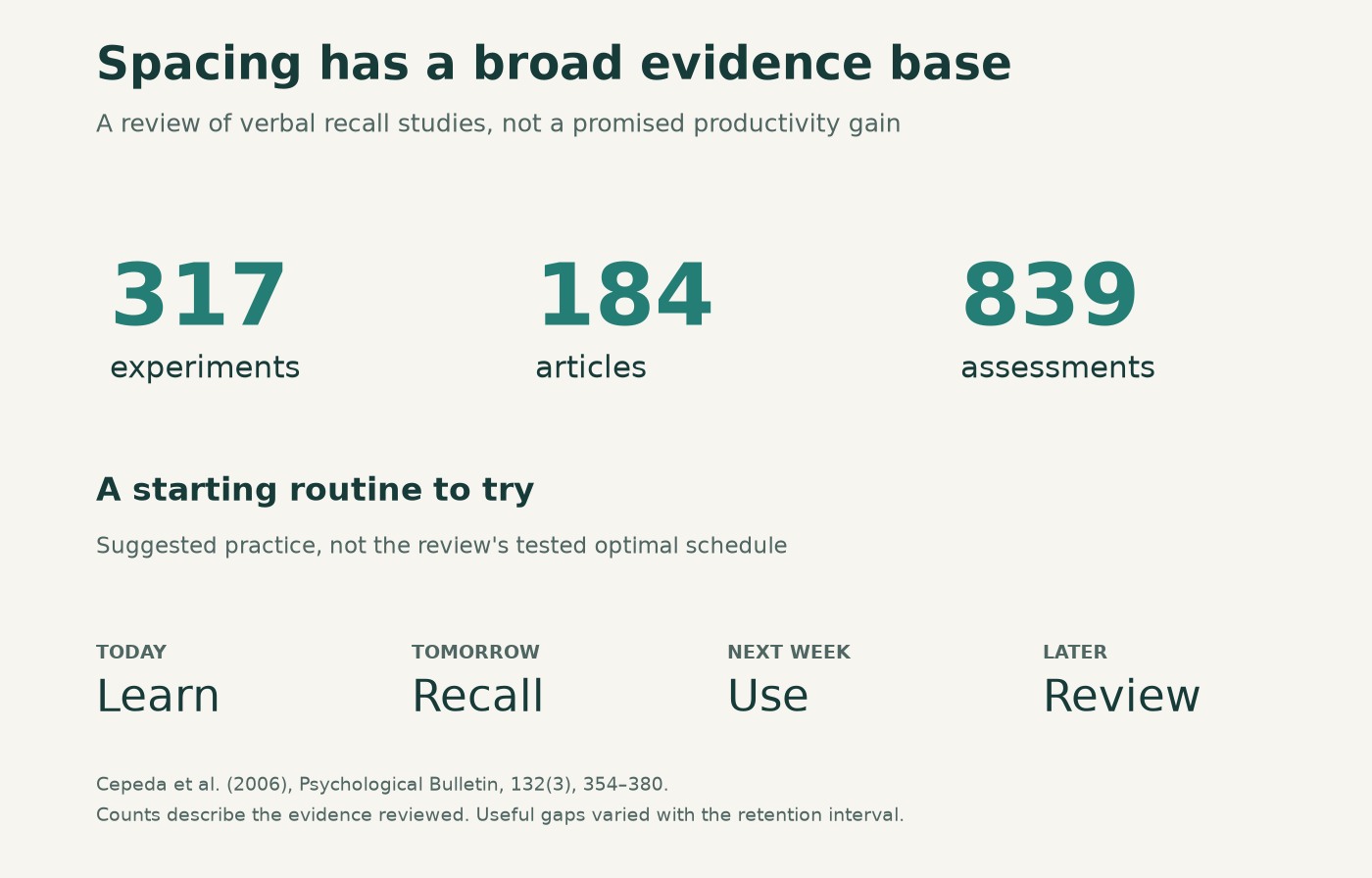
Research counts from Cepeda et al. (2006). The schedule is my suggested starting experiment, not a tested optimal sequence or an estimated effect size. Source.
I would start with a brief recall tomorrow, a small application next week and another review when the task returns. If it is effortless, extend the gap. If it has disappeared, shorten the gap and use a simpler example. Keep a few questions worth returning to; turning every paragraph into a flashcard becomes another form of collecting.
Working memory is the small amount of information we can keep available while using it. Cowan’s review found capacity around three to five chunks under particular conditions that limit rehearsal and regrouping. It is not a fixed limit of four browser tabs or four responsibilities. A “chunk” also changes with what a person already knows. Cowan’s review.
My practical response is to put the current goal, relevant facts and next step in one visible place. A short checklist or sketch frees me from mentally rehearsing them while trying to reason. That is an application of the capacity limit, not a claim that a checklist enlarges the brain’s storage.
Interruptions add another difficulty. In two experiments, Sophie Leroy found that attention could remain on an unfinished task and hurt performance on the next one. Attention residue study. I take this as a reason to make switching more deliberate, not evidence for an exact number of minutes lost after every interruption.
Before I switch, I leave a restart note: what I was doing, what remains uncertain and the next physical action. “Investigate model” is hard to restart. “Open case 7 and compare the currency with the source receipt” gives my attention somewhere to go. For a nontechnical task, it could be the next person to call and the question still unanswered.
A team can use a small shared interruption window while keeping a route for genuinely urgent work. Protect one block for a meaningful task, then see whether people need fewer restarts. The right duration depends on the work and the people doing it.
An AI tool can explain an unfamiliar term, produce a contrasting example or quiz me on approved material. I still want to make my own attempt before looking at its answer. Otherwise I can mistake a fluent explanation on the screen for understanding in my head.
I might ask it for three questions based only on a source I provide, answer them with the source hidden, then check both my answer and its feedback against that source. The research above supports recall practice. It does not establish that any particular AI tutor is accurate or improves learning.
I also want to leave room for rest. In a laboratory motor-sequence task, Walker and colleagues found improvements after a night of sleep that were not seen across an equivalent waking interval. That is evidence about a particular kind of memory consolidation, not a promised gain in business output. Sleep and motor learning study. It is enough to make me suspicious of a learning plan that depends on repeatedly borrowing time from sleep.
Use a notebook or a plain text file. No subscription or special learning system is needed.
| When | What to do | What to keep |
|---|---|---|
| First session | Pick one recurring problem and a small example | Desired outcome and starting result |
| After reading | Close the source, explain it, then check | One gap and its correction |
| Next day | Recall the main idea before reopening notes | What survived without help |
| Next week | Use it on a slightly different case | A result, including what failed |
| End of two weeks | Decide whether to keep, change or stop | One useful change to your work |
Count things you can explain or do, errors you can now catch, and whether the chosen task improved. For a small team, share one worked example and one unresolved question. Avoid ranking people by flashcards completed or links read.
Some experiments will show that a tool is not useful enough, or that the original problem was misunderstood. That is a result worth keeping. I want to get better at that judgement as much as I want to get faster with the next tool. There will always be more to read. The part I can control is the quality of the next attempt.

Legal Stuff